"Dune: House Atreides" by Brian Herbert & Kevin J. Anderson
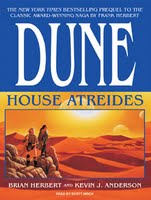
"Dune: House Atreides"
by Brian Herbert & Kevin J. Anderson
read by Scott Brick
Produced by Tantor Media
approx. 26.5 hours
Back in 1999, Brian Herbert discovered some manuscripts left behind with more information on the universe of Dune, written by his father Frank Herbert. Teaming up with Kevin J. Anderson they began a quest to add more stories to the "Duneverse" based on these manuscripts and their own talents in writing Science Fiction. The first was the "Prelude to Dune" series. This book "House Atreides" was the first in this series.
Tantor Audio has re-released these books in audio book form and this time they aquired the award winning voice of Scott Brick. Back when I first started listening to audio books Scott Brick was the first reader I heard. After hearing his performance I became a huge fan of audio books. There's a reason Mr. Brick has won so many awards. His voice is completely adjustable to any genre and his talents are fully expressed when reading a book with multiple characters. When expressing the voice of another speaker in the dialogue in the book he can, with the subtlest of changes, change characters so the listener is treated to what nearly sounds like a multi-cast performance. At the same time he can add the characters emotions into the voice to the utmost perfection. Scott Brick is no stranger to the "Dune" series, he has voiced many of the audio books so he knows the material and I would have to say he is the perfect choice for the re-issue of these books.
"House Atreides" gives some information on the buildup of what created the situations leading to the epic novel "Dune," by Frank Herbert.
An aging tyrant emperor rules the known universe, Emperor Elrood Corrino IX, and his son Shaddam IV, cannot wait for him to die, so that Shaddam may become emperor. He and his minion, Hasimir Fenrig devise a slow poison to kill off the old man so Shaddam may sit in the "Golden Lion Throne."
While this is going on Elrood has some schemes going that could change the universe. Spice Melange, only found on Arrakis (Dune), is needed for the Spacing Guild to fold space, it prolongs life, and is highly addictive. "He who controls the spice, controls the Universe." So Elrood has set out to devise an alternative to spice. Teaming up with the genetic scientist race of the Tleilaxu, Elrood has commissioned them to develop the newly engineered spice. As payment to the Tleilaxu, Elrood plans a takeover of the machine planet IX, where in place are the facilities for such a genetic engineering feat. To do this the House Vernius must be defeated. Instead of laying back and being defeated the house goes renegade, meaning they are no longer supported or recognized by the league and are criminals. The children are sent to Calidan to live with Duke Paulus Atreides. They are raised along with the Duke's son, Leto Atreides.
Meanwhile the Bene Gesserit discover they are only 2 or 3 generations from the Kwisatz Haderach, a prophesied messiah figure. But first they must get Baron Vladimir Harkonnen to "donate the genetic material." The first union of a Bene Gesserit sorceress and Harkonnen is deformed and must be repeated. This time Harkonnen violently rapes the sorceress and in the process she curses him with an incurable disease.
On Caladan, Paulus Atreides dies during a bullfight with a drugged Salusan Bull, and Leto becomes Duke. House Harkonnen has developed a ship that renders itself invisible. And frames House Atreides for an attack on the Tleilaxu.
In the meantime on Arrakis, Dune, Pardot Kynes a planetologist sent by Emperor Elrood, arrives on Arrakis and begins his duties there. He starts to dislike the Harkonnen rule there, and is getting more and more interested in the native Fremen of the desert and the possibility of terraforming the planet. Pardot is discovering more and more proof that some time, long ago, Arrakis was covered with giant oceans, and gets curious about what changed the climate to what it is today.
Once again another book filled with lots of material lots of action and great political interaction.
Labels: audio book, audiobook, book review, books, brian herbert, dune, frank herbert, house atreides, kevin j. anderson, prelude to dune, sci-fi, Science-Fiction, scott brick, tantor audio
posted by Gil T. @ 9:48 PM


Winds of Dune by Brian Herbert and Kevin Anderson
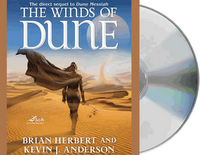
Winds of Dune
by Brian Herbert and Kevin Anderson
Read by Scott Brick
Produced by Macmillan Audio
Run Time: 18:30
Brian Herbert and Kevin Anderson continue to explore the Universe of Dune created by Brian's Father Frank Herbert, with this latest installment, "Winds of Dune." The Duneverse is filled with opportunities to write side stories or fill in gaps between the original novels. This job could not be done by just any Sci-Fi writer, and the team of Herbert and Anderson have not only done the job but they have done the job without taking anything away from the original stories. In fact, they have added more to the series that seem as though they should been there from the beginning.
The Winds of Dune begins after the events of Dune Messiah and jumps back and forth in time to before Paul Atreides came to dune and to the times during Paul Maud'Dib's Jihad.
Paul has walked off into the sand, blind, and is presumed dead as told by Frank Herbert at the end of "Dune Messiah", Jessica and Gurney are on Caladan; Alia is trying to hold the Imperial government together with the Duncan Idaho Ghola; Mohiam is dead at the hands of Stilgar; and Irulan imprisoned. Paul's former friend, Bronso of Ix, now seems to be leading opposition to the House of Atreides. With the characters from the classic novel in place Herbert and Anderson tell a story of true friendship, true love and the bonds of family.
After hearing of her son's death Jessica, Duchess of Caladan, and Gurney Halleck, Earl of Caladan, return to Dune to mourn the death of Paul and his concubine, Chani (also mother of Paul's children, Leto & Ghanima). During Paul's funeral there is great celebration in the life of Dune's Messiah, Paul Maud'Dib. The funeral is interrupted by Bronso of Ix (one of Paul's childhood friends) claiming Paul is not the Maud'Dib but simply Paul Atreides. Bronson of Ix has spent all his time, since Paul became the Messianic Emperor of the Universe, trying to thwart all the attempts at making Paul out to be a god, by simply pointing out his human flaws. Irulan is told by the now Empire's Regent, Alia, (sister of Paul, and the Bene Gesserit abomination) to write only things that put Paul in a positive light or she may be tortured or put to death.
Jessica then tells Irulan why Bronso is writing these negative things about Paul. This takes the book on its first flashback, in which the listener is told of a time when Paul and Bronso of Ix first met and why they became best friends. Both boys were only about 12 or 13 years old when Paul was sent to learn about the manufacturing based planet of Ix. Both houses, Vernius of Ix and Atreides of Caladan are very close due to Duke Leto of Caladan once marrying a descendant of Vernius, and both boys pledge their loyalty to each other to their fathers. The Bene Gesserit are upset with Bronso's mother (a Bene Gesserit, herself) and demands she returns to Wallach IX to become a breeding mother. She resists and the Bene Gesserit use a Guilt caster to put her in a catatonic state. Not knowing what to do Prince Rhombur sends her with the Bene Gesserit in hopes of finding a cure. Rhombur then reveals to Bronso that due to the accident that left Rhomber a cyborg he was not able to father a son and that Bronso is not his natural son. Bronso runs away and out of honor Paul runs with him.
During this adventure Paul and Bronso are befriended by a leader of a Jongleur troop. Jongleurs are traveling performers, so this makes this adventure very similar to the boys running away and joining the circus. During this excursion Paul and Bronso learn some Jongleur techniques including a form of mass hypnosis, which comes in handy when Paul becomes the Maud'Dib.
Flashback to the books real time and Alia is using all forces available to capture Bronso. For a reasons unknown at the time Jessica has Gurney Halleck stall the capture. Gurney is working with the Ghola Duncan to track down Bronso, and through his undying loyalty to House Atreides Gurney stalls as best he can. Meanwhile anyone caught with anti-Paul Maud'Dib material is put to death under orders of Alia.
Jessica then takes Gurney and Irulan out to the desert to finish her tale of Paul and Bronso. This Flashback goes back to when Paul has become Emperor and the Maud'Dib and the empire is fighting Paul's Jihad.
Jessica has been called to Wallach IX by the Bene Gesserit. They want her to kill Paul so that his empire will crumble and the Jihad will end. While making her decision Jessica discovers Bronso's mother, while not completely healed, alive and awake on Wallach IX. Jessica is called to Ix by Bronso and when she arrives on Ix she finds Paul with Bronso. Here Paul reveals that Bronso is to spread the word Paul is a mere human to keep the Mythology of Paul Maud'Dib at bay.
Back in the book's real time Bronso is captured and is sure to face execution. This book goes perfectly along the lines of all the books in the Duneverse, in that it again is filled with plans within plans and no one knows the complete story until the very end.
Once again Scott Brick performs in his usual stellar reading, creating the mood and emotions of the book from the words written by Herbert and Anderson. Brick is perfect at the subtle changes in mood and thought by small shifts in his voice that keep you glued to "Winds of Dune."
Labels: alia, audio book, book review, books, brian herbert, duncan idaho, dune, dune messiah, frank herbert, heretics of dune, irulan, jessica, kevin j. anderson, paul of dune, winds of dune
posted by Gil T. @ 3:36 PM
Heretics of Dune by Frank Herbert audiobook review
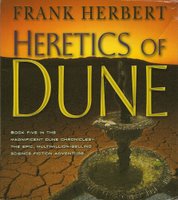
Heretics of Dune
by Frank Herbert
Produced by Macmillan Audio
Read by Simon Vance
What makes the original Dune series by Frank Herbert a classic in all science fiction is the fact that Frank Herbert created not only a story, but several religions, cultures and conflicts. Every book in the series works around the politics of these and yet still has something to say about today's society (no matter when that "today" is).
This audiobook production is read by Simon Vance. His reading not only keeps the listener in the complicated and twisting storyline but his vocal qualities create great characterizations that at times the production seems like a multicast recording.
The Heretics of Dune presents another view in the "Duneverse" this time exploring the meaning and purpose behind the emotion (and all that goes with it) of love. The heresy, which all the heretics presented in this book are guilty of, is Love. The Bene Gesserit have a breeding program in which the genetic line of the Atreides is preserved. No Bene Gesserit witch is allowed to fall in love. After all that is what Lady Jessica did in the original novel, and that created a Kwisatz Haderach, a being that could be in all places at once, and later the tyrant, God Emperor, Leto II.
The book takes place 1,500 years after the reign of Leto II. Arrakis, Dune has returned to being the desert planet, thanks to the sandtrout of Leto II's destruction bringing back the sandworms from extinction. The planet is now called Rakis. Another planet of note, Geidi Prime, former homeworld for House Harkonnen is now known as Gammu.
The empire fell into chaos before the return of the sandworms, due to the scarcity of spice. This created the "Scattering" in which many of the population sought the extreme edges of the universe to find other sources of spice or to expand the location of humanity. As the books opens many people have returned and have changed. There is a new force to deal with, the Honored Matres, they are very similar to the Bene Gesserit but the Matres use sex as a weapon and force of rule. The Bene Gesserit and Bene Tleilax see this as threat and somewhat team up to fight these Honored Matres.
The Bene Gesserit have been using gholas of Duncan Idaho through the years but the Tleilaxu always assassinate the ghola. A ghola is a clone that is capable of full memory of their past self. This time will be different, the Bene Gesserit have a plan. But, as it seems so do the Tleilaxu. They have "programmed" the ghola to kill the Bene Gesserit "imprinter" that tries to imprint him to guarantee his loyalty to the Bene Gesserit.
In the meantime on Rakis, a child is discovered by the priests that can control the sandworms. The Bene Gesserit hear of this and immediately take over Rakis, in order to make the child, Sheeana, a Reverend Mother, and maybe to breed with the Duncan ghola.
The Honored Matres also find this out and seek to destroy the ghola and the girl and Rakis. So with many battles to ensue we are introduced to a retired Bashar, Teg, who is brought out of retirement to not only guard the ghola but to awaken his memories due to Teg being the exact likeness of Duke Leto I. After awakening the ghola Teg, Reverend Mother Lucilla, who was supposed to imprint Duncan before the awakening, and Duncan are discovered on Gammu and have to go underground to get to Rakis. Teg is captured and tortured by the Honored Matres but during the torture some strange powers are awakened in him. He is able to speed his body and mind outside the normal flow of time, and able to destroy all occupants in a Honored Matres stronghouse. He then steals a no-ship (which is a ship undetectable by all, including prescience vision) and takes Lucilla and Duncan to Rakis.
With many plots entangled into one final outcome this book is yet another great representation of the "Duneverse" created by Frank Herbert.
Labels: audiobook, book review, books, dune, frank herbert, heretics of dune, macmillan audio, sci-fi, Science-Fiction
posted by Gil T. @ 1:22 AM
Paul of Dune by Brian Herbert& Kevin J. Anderson (2008)
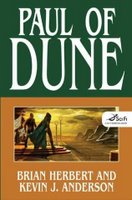
Paul of Dune by Brian Herbert& Kevin J. Anderson (2008)
Read by Scott Brick
Published by Macmillan Audio
Running time 18.5 hours
Published 2008
In the world of science-fiction, one of the best series of books to come down the pike is the Dune series created by Frank Herbert. After Frank Herbert's death, his son, Brian Herbert, teamed up with sci-fi author Kevin J. Anderson and pretty much wrapped up the series by providing 6 prequel and 2 sequel books. The prequels offered some backstory to events and ideas only barely mentioned by Frank Herbert in the original series. The sequels ended the series that had a huge cliff-hanger which Frank Herbert left when he passed away. So with all of that taken care of, one has to ask, what more is there in the Dune Universe? (Or the Duneverse)
Actually, there is the potential for lots more. Brian Herbert and Kevin J. Anderson, with the backing of the Herbert estate, are just the folks to provide more stories in the Duneverse. Paul of Dune is one of three novels (at least only three planned so far) filling in some gaps and providing the fans of Dune with some more stories to devour. After all, "The spice must flow."
This audiobook is read by Scott Brick. I will have to say that Brick is one of my favorite voices for audiobooks. I first heard him when I was listening to the audiobook "In Cold Blood" by Truman Capote. He expressed such great emotion in that book. Then later, when I was making it my mission to read or listen to every book in the Dune series, I heard his voice again in the prequels. I was glad to hear he was voicing this one as well. Brick can express emotion and characterization with such subtlety that, while you are still getting the same reader, your ears are treated to a near dramatization.
His voice-work really shapes a character. In the book "Dune," Count Hasimir Fenring was Emperor Shaddam's right hand man. Frank Herbert had written in quite a few strange speech patterns, like lots of nasal sounds, and would create sentences similar to: "mmmmwah, I think we can destroy House Atreides, mmmmmm." While this could have presented challenges for some narrators, Brick works these into his reading to sound like the character does not have a speech problem but is thinking as he's speaking. This approach makes these moments ring with clarity and portrays a new dimension of the not-so-good Count’s personality, who plays a vital role in Paul of Dune.
All the books in the Dune series feature plans within plans, conspiracies within conspiracies and plots within plots. As a result, many scenes include both the speech and thoughts of various characters. Brick reads these sections without flaw so the listener is not confused as to what is said aloud or thoughts the character shares with no one.
Paul of Dune takes place essentially between the time of the original novel Dune and the second book Dune Messiah" Paul Maud'Dib is in control of the planet Arrakis, Dune, and is the emperor of the known universe. The former Padisha Emperor Shaddam Corrino, IV, has been exiled to the planet Salusas Secundus, the training planet for his Sardaukar army which were defeated by Maud'Dib and have since joined the jihad of Maud'Dib.
This book tells more of what happened during the jihad and of the assassination attempts on the Emperor Paul Maud'Dib. Another interesting aspect of this book is that it also covers the time before Paul Atreides (soon to be the Maud'Dib) came to the spice planet, Arrakis, Dune. In flashback sequences Paul is making sure that Princess Irulan is telling the actual story of his life and the reader is transported to the War of Assassins which occurred when Paul was only 12. In the Dune timeline this would be between the prequel book "House Corrino" and the original book, "Dune." It feels as though you are getting two novels in one, but both stories meld into a single idea and fantastic climactic end.
Listen to the audio review below.
Click here to get the MP3 podcast file from sfsite.comOr click on the graphic below for other sci-fi audiobook reviews...some by me..some not.

Labels: brian herbert, dune, frank herbert, kevin j. anderson, paul of dune
posted by Gil T. @ 8:37 PM
The Road to Dune by Brian Herbert, Kevin J. Anderson, Frank Herbert (published by Tor Books, 2005)
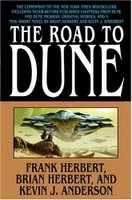
Any true science-fiction fan can tell you that one of the classics of Sci-Fi is the Dune Series created by Frank Herbert. If you have taken it upon yourself to read the entire series you'll remember that Frank Herbert died and left the series a real cliffhanger. Some dedicated dune fans will say that is what he intended but some will say he had more to write. Frank Herbert's son, Brian has teamed up with another sci-fi author, Kevin J. Anderson and working with Franks notes and stored treasures left behined have brought the Dune series to a close. They have also augmented the series with some great prequels also using ideas they found in Frank Herbert's many writings, and to this day they are adding more stories and books to the Duneverse with the recent publication of "Paul of Dune." (note: I'll be reviewing this book soon...I have the audiobook sitting on my shelf waiting for my devouring.
So we've got more stories and the Duneverse continues but what led to the coming of the classic that is "Dune?" Well that brings us to this review. Not only did Brian and Kevin find story plotlines in the cache of documents left behind by Frank Herbert, but they found many other treasures, some including rejection letters. This book is a multi-treat for science fiction fans and die hard Dune fans. In this collection there are letters from publishers about why "Dune" would not be a good book and would never sell. Also included is the original story that Frank Herbert wrote called "Spice Planet" which is the basis of what would be "Dune." This is the original and even though the basic story is still there, this novella doesn't grasp the environmentalism, religion and politics as the final does. I'm glad he rewrote it.
The surprising thing about this book is that so many publishers turned down the book, not because of being a bad story, but because the book was so long. In fact the original publisher, Chilton, published only automobile manuals and took a chance that worked out well for them.
Included in this book is the original, never published news story about stopping sands from destroying coastal towns in Oregon which got Frank Herbert scheming of a planet of sand. Other goodies in the book are some short stories by Brian Herbert and Kevin J. Anderson, three of them bridging the gap between the 3 books covering the Butlerian Jihad, and one taking place during the Harkonnen takeover on Dune in the original first novel, "Dune."
This book is a very nice compliment to the Duneverse, in that it provides insight into the mind of Frank Herbert and the development of the famous spice planet, Dune, and some added stories that add to the thousands of years covered throughout all 14 (now 15) books.
Labels: book review, books, dune, frank herbert, road to dune, Science-Fiction
posted by Gil T. @ 1:26 PM
Book Review/Discussion: Sandworms of Dune by Brian Herbert and Kevin J. Anderson
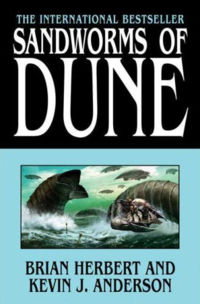
The Dune chronicles have come to a close with this final book in the series, "Sandworms of Dune." Frank Herbert created a great novel in the original "Dune" and then continued with 5 more books covering the philosophies and adventures of the planet Arrakis or Dune. Dune is the only place in the universe where Spice Melange was to be found. "He who controls the spice, controls the Universe." The Spice was needed for Guild Navigators to be able to fold space, enabling travel throughout the universe in the blink of an eye. Spice also was known to bring about psychic prescience in some individuals. The Spice is what gave the Bene Gesserit witches their powers. Finally Spice was known to prolong life. Spice was the commodity to be traded instead of coin in Frank Herbert's "Duneverse."
The last book Frank Herbert wrote in the series was "Chapterhouse Dune." In this novel the planet Arrakis (Dune) had been destroyed and the universe was dividing into many separate factions, and an unknown enemy was coming in to destroy all traces of humanity. Of course, this left a major cliffhanger for all Dune fans, and Frank Herbert's Death made it so we would never know what happened.
Enter Frank Herbert's son, Brian. Brian Herbert teamed up with fellow science fiction writer Kevin J. Anderson after finding Frank Herbert's notes on the final book of Dune. He and Kevin Anderson put together the notes and found they had what Frank had intended for the ending of the book. As they worked together on the final book they wrote some prequals to the series; The Legends of Dune Series which covered the times which led to the outlawing of "machines in the likeness of the human mind" (Thinking Machines) and the Prelude to Dune series which described how the major Houses in the Dune series came to power.
With the backstory in place it was time to finalize the Dune series. In putting together the material the 2 authors discovered there was 2 books worth of material so they wrote 2 final books in the series; "Hunters of Dune" and this book, "Sandworms of Dune." Now the series is over. Or is it? This final book "Sandworms..." brings about a great closure to the series but the younger Herbert and Anderson are prepared to write some more books for the series. These will be a trilogy titled "Heroes of Dune" with the separate books focusing on "Paul of Dune," "Jessica of Dune" and "Irulan of Dune." The release dates of these books are some time in 2008 or 2009.
Let's start now on this book by saying that Brian Herbert and Kevin J. Anderson have wrapped up the series in a very pleasing way for the fans to actually have some closure on all the major characters in some form. At the same time they maintain the philosophy and feel of the original books creating a seamless story from the point where Frank Herbert left off. Many fans felt cheated that the great unknown enemy turned out to be robots, the Evermind Omnius, and thinking machines. I can see that some could have been misled thinking that the great enemy could be spiritual but if you read the series you can see there is some great schism that occured in the books' mentioning of "The Butlerian Jihad." Out of this Jihad a law came to pass, "Thou shalt not create machines in the image of a human mind." Herbert and Anderson in writing the prequals and these final 2 books have very adequately explained this rift and turned it into a great climax to the stories.
In this book, humanity is continuing to fracture in to several factions while a single enemy will be using this division to destroy all human life. The factions consist of; The newly combined Bene Gesserit and Honored Matres, the "no-ship" on which are several Bene Gesserit who don't agree with the merging of the Honored Matres into the Bene Gesserit order, the Spacing Guild are replacing all navigators (who are dependent on spice) with machines that will fold space, since spice is a rare commodity, the Navigators who are being sacrificed are combining forces and getting help from the mysterious "Oracle of Time," The new breed of Face dancers who are not only able to look like whoever they want but also to take the memories of those they take on the appearance of, and finally the fast approaching thinking machines led by the Evermind, Omnius and his co-hort the independent robot Erasmus.
The character of Erasmus the independent robot is one of the most fun love-to-hate evil villians I've read in a long time. His character is one that represents curiousity. He's constantly wondering what makes humans tick. In fact, just like Pinocchio and Data from "Star Trek the Next Generation," Erasmus just wants to be a "real boy," or rather he wants to be human and experience such human traits as love, honor and faith. In the experiments on finding out what makes a human love another human or object Erasmus created some bloody dissections of the human brain and heart in the prequal books. The Evermind Omnius represents the logic and facts portion of humanity. Great characterization exists here and all created by Herbert and Anderson.
The no-ship containing the faction of Bene Gesserit that didn't want to merge with the Honored Matres continues to hide in the universe while at the same time searching for a new home for the Bene Gesserit and the Jews. The Jewish faith has lived on for tens of thousands of years escaping the new religions that have come and gone in the universe over time and the last few known Jews have escaped on the no-ship. The ship is commanded by the ghola of Duncan Idaho and the Bene Gesserit on the ship are led by Shianna who is able to communicate to the sandworms. On this ship there are 5 sandworms which were rescued before Arrakis was destroyed by the Honored Matres. Also on board are other gholas grown from cells found in the last Tleilaxu Master, Scytale's null entropy tube. A ghola is a clone of a human which has the capability to "awaken memories" of the person they once were. The gholas are; Paul Maud'dib Atreides, Lady Jessica Atreides, Chani (Paul's Wife), Liet Kines (planetologist on Dune), Stilgar (Naib of the Fremen on Dune), Yeuh Wellington (Suk Doctor that betrayed Duke Leto in the original Dune book), Alia (sister of Paul and an abomination). These are basically young children until their original memories are restored.
Duncan is constantly barely escaping the tachyon net thrown out by the thinking machines to catch the no-ship. The thinking machines know that a Kwisatz Haderach (a super human who is able to be in all places at once) is on board and wants to possess him to win the war against humanity. But at the same time the no-ship is being sabotaged by an unknown person and the running away from the thinking machines is becoming impossible.
Another Tleilaxu, Waff, is working with the guild navigators to create a new source of spice. He genetically alters the sandworms to create worms that can live in the ocean and they create a new form of spice "ultra-spice." These new worms are planted on the ocean planet of Buzzel and soon thrive.
The new order of Bene Gesserit and Honored Matres are preparing for the arrival of the thinking machines by creating a fleet of ships and weapons to destroy the enemy. They hire the guild and Ixian forces to create the ships and weapons. But soon find out that the guild and Ix is infiltrated with face-dancers working for the thinking machines.
The climactic battle between humanity and the thinking machines is one that creates a great philosophical discussion to be had by all that read the books. This being, that mankind can find peace through cooperation. I've decided not to give any real spoilers because this book must be read and appreciated.
Labels: book review, books, brian herbert, dune, frank herbert, Science-Fiction
posted by Gil T. @ 9:35 PM