Reefer Madness Sex, Drugs, and Cheap Labor in the American Black Market by Eric Schlosser
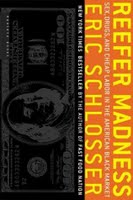
Reefer Madness Sex, Drugs, and Cheap Labor in the American Black Market
by Eric Schlosser
Read by the author
Produced by Simon & Schuster Audio 2003
Okay one more non-fiction book and then I'll get back to some more fiction. I picked up this audio book because I read the author's book on the meat and fast food industry, "Fast Food Nation." For a while after reading that book I would not touch fast food mainly because of the gross out factor caused by Eric Schlosser's expose' of the unsafe practices in those industries. Schlosser also exposed the greed and the lack of concern for the consumer's of those same products and the employees of the companies involved. The one thing that Schlosser excelled in was in following the money.
This book is no exception, in fact that's pretty much the gist of the book, following the money. "Reefer Madness" is a look at the three pillars of the underground economy of the U.S., estimated to be ten percent of American GDP: marijuana, migrant labor, and pornography.
In Reefer Madness, the first section of the book Schlosser argues, based on usage, historical context, and consequences, for the decriminalization of marijuana. This section revolves around Mark Young of Indiana, who was sentenced to life in prison without parole for his relatively minor role in a marijuana deal. This is one of the examples of marijuana laws being unreal, where in many states marijuana possession can get harsher penalties than committing murder.
In the Strawberry Fields, he explores the exploitation of illegal immigrants as cheap labor, arguing that there should be better living arrangements and humane treatment of the illegal immigrants America is exploiting in the fields of California. This segment seems like either an epilogue or prologue to this previous book "Fast Food Nation." In fast food nation the migrant workers/illegal immigrants are used in meat packing in extremely unsafe conditions and with very little pay. In this segment of the book those workers are trying to squeak by on very little money doing jobs no one wants to do. In one conversation the farm owner says every once in a while some college kids come looking for work but the work is so difficult they don't last half a day.
One thing I always found curious was; Why don't the farmers that employ illegals use machinery to do the harvesting and get rid of the problem of illegals sneaking across borders to do back breaking work? Schlosser explains this, and I'm summing up the explanation here, by saying for farms to do the work with the machinery an initial purchase of said machinery would cost into the millions and right now they only spend thousands paying the migrant workers, also that we Americans like for our fruit and vegetables to not be blemished and the workers can pick with care unlike the machines.
An Empire of the Obscene details the history of pornography in American culture, starting with the eventual business magnate Reuben Sturman, an enigmatic Ohio man who started out selling discarded comic books from the back of his car goes on to buil and control a formidable pornography empire. After beating a string of obscenity charges the government finally catches Sturman in the only way possible, tax evasion. Finally the government can put Sturman behind bars. But after all the court cases against Sturman bringing down religion based obscenity laws the business of pornography becomes a major business now backed by many Fortune 500 companies.
Schlosser unravels an American society that has "become alienated and at odds with itself." Like "Fast Food Nation", this is an eye-opening book with Schlosser doing some serious investigative leg work. Schlosser doesn't really come out in support of the Porn Industry or the legalization of drugs but does point out the hypocrisy that gives a marijuana user life and a murderer 10 years as sentencing and jailing obscenity while major corporations fund it, while that same America promotes indentured servitude (slavery) for the illegal immigrants. "..the price of freedom is often what freedom brings."
Schlosser closes by arguing that such a widespread black market can only undermine the law and is indicative of the discrepancy between accepted mainstream American culture and its true nature.
Labels: audio book, book review, books, eric schlosser, illegal, illegal immigrants, marijuana, non-fiction, pornography, reefer madness
posted by Gil T. @ 10:14 PM


"Stranger Than Fiction: True Stories" by Chuck Palahniuk
"Stranger Than Fiction: True Stories"
by Chuck Palahniuk
Published by Anchor Books 2004
After a long run with reading some serious hardcore science fiction and fantasy novels I had to take a break and read some non-fiction. This tells you what genre my next book review will fall under. Anyway, I decided to ease into the Non-fiction by reading this book by one of my favorite authors, Chuck Palahniuk. Chuck is the author of some pretty strange pieces of fiction, many of you know of "Fight Club" and maybe "Choke" both of which were made into pretty decent film adaptations. The reason I consider this book easing into the non-fiction genre is that,well, to put it bluntly, reality in Chuck Palahniuk's world can be surreal.
This book is a collection of essays, stories, and interviews written for various magazines and newspapers. Some of the pieces had also been previously published on the internet. The stories cover 3 main categories: "People Together", articles about people who find unique ways of achieving togetherness; "Portraits", interviews and short essays mostly about famous individuals; and "Personal", autobiographical pieces. The introduction to the book is Mr. Palahniuk talking about the world of writing and what it takes to be a fiction writer, very interesting, indeed. The book then breaks into the first story, "Testy Festy," which covers the immoral and deviant behavior that happens at the Rock Creek Lodge Testicle Festival in rural Montana. From the opening line of that story I thought, uh oh, what have I gotten myself into? Well he is merely reporting the goings on of this raucous festival and it is definitely "Stranger than Fiction."
There are several stories in this collection that range from the bohemian activities of the Testicle Festival to celebrity interviews with Juliette Lewis and Marilyn Manson to some autobiographical essays in which the reader learns more details behind the murder of his father by the father's girlfriend's psychopathic ex-boyfriend.
Some of the stories are very funny and some are quite poignant. One of the funnier ones is his coverage of the Lind Combine Demolition Derby in Lind, Washington. Rednecks crashing combines seems like it would be fun. One of the stories is "The People Can" where chuck is reporting on the life of the crew on board the submarine USS Louisiana. Being an ex-Navy man myself I found the civilian insight on this story very interesting. One of the saddest stories is when he tells of his life as an assembly-line drivetrain installer by day, hospice volunteer driver by night.
So if you are a Chuck Palahniuk fan you will find this collection of true stories very interesting told from his point of view. If you have yet latched on to the writings of Palahniuk check this one out, it will prepare you for the world that is in Chuck Palahnuik's novels.
Labels: chuck palahniuk, essays, fight club, non-fiction, stranger than fiction, true stories
posted by Gil T. @ 8:26 PM
Nietzsche in 90 Minutes (Philosophers in 90 Minutes series) by Paul Strathern (Publisher: Ivan R. Dee, 1996)
When I took Philosophy in college I had had an interest in making it my major. But I looked to the future and asked around about why one would do such a thing. The biggest answer I received was: "to make the parents mad." But since I paid for my own education (2 Bachelor degrees and one Associates, fyi), I knew the only person I would tick off was myself. Okay, actually it was Sallieae and me paying for the school and Salliemae wants her money back...so I'm still paying, but that's beside the point.
I did take a philosophy course as a requirement, and loved the idea of sitting around thinking and making profound statements. I chose to go the route of Broadcasting / Theatre / Electronics instead (crazy mix there...but it makes sense now). But I do now have time to enjoy a good read and the title of this book "Nietzsche in 90 Minutes"intrigued me. This book is part of a philosophers in 90 minutes series which provides nice information to supplement my autodiadactism.
I chose Nietzsche as my first because he was so misunderstood. He's been credited with the Nazi final solution. But in reality it was Nietzsche's sister that created the pure race Superman that the Nazis took as their goal. After his death Nietzsche's sister re-wrote some of his diaries creating the "Will to Power" publication Hitler used as propaganda. The book has been rewritten since, to create more of what Nietzsche intended.
Basically this book is a quick reference guide. Beginning with a biography the reader learns what formed the man that formed the "will to power" philosophy and later to claim "God is dead." His major concept is the will to power, which he saw as the basic impulse for all our acts. Christianity he saw as a subtle perversion of this concept—thus Nietzsche’s famous pronouncement, “God is dead.”
The book also contains a section featuring cronologies on Nietzsche's life, Nietzsche's Era and Philosophical dates, along with a section with choice quotes.
This book is a great quick reference, but not the end all on Nietzsche. So for a graduate student, hopefully you are looking at more in-depth texts, but for the curious and those seeking some interesting reference 90 minutes is not too much time to waste on understanding a philosopher.
To wrap things up here are some of my favorite Nietzsche quotes:
Talking much about oneself can also be a means to conceal oneself.
I cannot believe in a God who wants to be praised all the time.
Without music, life would be a mistake.
What is done out of love always takes place beyond good and evil.
Labels: book review, books, nietzsche, non-fiction, philosophy
posted by Gil T. @ 8:08 PM
"Stiff: The Curious Lives of Human Cadavers" by Mary Roach (pub. W. W. Norton & Company 2003)
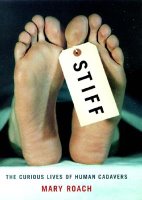
I recently read Mary Roach's book, "Spook: Science Tackles the Afterlife," and was impressed by the way the author not only could explain the science of death and dying but that she did it with great wit. I mean there were times while reading the book I would catch myself laughing out loud, and have to look around and make sure no one thought I was a bit crazy. But no one did...or at least none that would admit it. Anyway, after that treat of non-fiction, educational but in a fun way, book I had to go back and read her earlier book, I was not let down. This book provided the learn something new but have some laughs along the way fun that I've now come to expect from Mary Roach.
Keep in mind she does look at this in a fun way, but in no way does Mary Roach make fun of the dead or dying. Humor with class and education is the best way to describe what is in this book.
In "Stiff:..." Mary Roach examines the many things that happen after a person ceases being a person. Mostly these people have donated their bodies for research, but in the past it was not always that way. So not only is there a bit of exploring what a cadaver is expected to go through, Mary Roach also gives a bit of a history lesson on the dead.
I think this book is best summed up with a list of the chapters, so here's a list of the chapters.
1. A Head Is a Terrible Thing to Waste: Practicing surgery on the dead
2. Crimes of Anatomy: Body snatching and other sordid tales from the dawn of human dissection
3. Life After Death: On human decay and what can be done about it
4. Dead Man Driving: Human crash test dummies and the ghastly, necessary science of impact tolerance
5. Beyond the Black Box: When the bodies of the passengers must tell the story of a crash
6. The Cadaver Who Joined the Army: The sticky ethics of bullets and bombs
7. Holy Cadaver: The crucifixion experiments
8. How to Know if You're Dead: Beating-heart cadavers, live burial, and the scientific search for the soul
9. Just a Head: Decapitation, reanimation, and the human head transplant
10. Eat Me: Medicinal cannibalism and the case of the human dumplings
11. Out of the Fire, into the Compost Bin: And other new ways to end up
12. Remains of the Author: Will she or won't she?
As you can see lots of interesting subjects and each chapter more informative and entertaining than the previous. Keep in mind this book is not for the squeamish. I will have to say that the book as a huge squirm factor, by that I mean if you , like me, have a hard time listening to very descriptive discussions about body parts and cutting into same and squirm around in your seat when you hear or read such, you'll be squirming throughout this book. However, I found the book very fascinating, informative and yes entertaining so I squirmed but read on.
Seriously you know you're in for some squirming when the book opens up with:
"The human head is of the same approximate size and weight as a roaster chicken. I have never before had the occasion to make the comparison, for never before today have I seen a head in a roasting pan. But here are forty of them, one per pan, resting face-up on what looks to be a small pet-food bowl. The heads are for plastic surgeons, two per head, to practice on...."
After this book I've decided I'm still not sure about what to do with my body after I'm done with it. I do support the "harvesting" of my organs but for the rest, i'm thinking seriously about the composting idea. (read chapter 11)
Labels: book review, books, born in death, cadavers, mary roach, non-fiction, Science-Fiction, stiff
posted by Gil T. @ 7:33 PM
"The Audacity of Hope" by Barack Obama (pub. 2006)
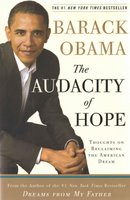
Anytime a politician writes a book and they haven't run for president yet, you know they will be. Well that's just what happened with Senator Barack Obama. This book was published in 2006 and can serve as a great tool to get to know the 2008 Presidential candidate.
The book talks about his run for Senator in Illinois and the people he met and the beliefs he stands for. In other words this book Is a good insight into what platform this candidate will stand on once elected. In the book he talks about “sensitive” topics like religion, racism, U.S. foreign policy and family.
I found it a great get to know the candidate book, in fact, so much so that I think all candidates should write such a book before running. That way when elected we can say, "well right here in black and white you said you stood for this...do you plan on making yourself a liar or can we believe you?"
The book is written in first person narrative. At times it feels as though you are sitting down and reading a letter from a friend with some very humble statments, such as while he's helping to propose Iran get rid of nuclear weapon capabilities he calls his wife to discuss the positive steps and his wife tells him to bring home ant traps, she's found ants coming into the kitchen and bathroom. While other times the passages feel as though you are reading a campaign speech. The good part about it is, that the moments of "speech" are heartfelt and do not use "political rhetoric" but in terms any American can grasp and, whether on the same side of the issue or not, can empathize with the Senator.
Empathy, that's a major issue in this book. Senator Obama mentions that many of todays youth and even many adults lack that same skill when it comes to everyday life. He mentions this throughout the book and in retrospect I can see his empathic skills are much needed in America's leadership, and has been lacking for about, oh, say maybe 8 years or so.
Okay personal jokes/jabs aside. I will say this today's culture has a serious Empathy Deficit Disorder. Really look around you, the rudeness in today's society can be directly attributed to lack of Empathy. For example, that guy/gal walking down the street or sitting next to you in the restaurant or theater yelling into his cell phone, do you think he/she cares that it is rude to others around? If he/she could empathize with others, they would probably be less rude. And that is just a minor example. Well I think the Senator from Illinois has hit this nail on the head.
Can our country use a little leadership with Empathy?
With topics like Faith, Race, Family, and of course Politics discussed in this book, I think that any person, Republican or Democrat would benefit in reading this book. If nothing else at least knowing what a certain candidate stands for.
A side note here; I don't care what email you received but nowhere in this book does Senator Obama claim to be a Muslim, so please stop sending that d**n spam email telling me that he is.
Labels: barack obama, book review, books, illinois, non-fiction, obama, presidential campaign, senator
posted by Gil T. @ 9:25 PM
"Spook: Science Tackles the Afterlife" by Mary Roach
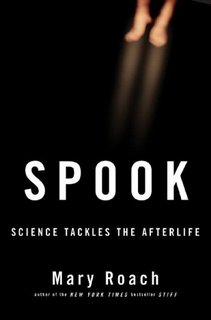
Okay, I can say whether you are a skeptic or a or a "believer," the afterlife, or what happens after we die intrigues all. C'mon admit it you do find yourself curious. Well Mary Roach has written a book for you. For the skeptics, well Mary is one herself, as for the believers Mary Roach seeks out scientific proof of the soul, heaven and the great beyond.
This book "Spook..." is actually a sequel to Ms. Roach's book, "Stiff: The Curious Lives of Human Cadavers." In "Stiff..," Ms. Roach explored what happens to cadavers/bodies after death. So why not go and find out what happens to the soul?
This book tackles the many aspects of the soul. From reincarnation to near death experiences. Mary Roach approaches the subjects with a mix skepticism and open mindeness, but let me tell you she does so with such a great sense of humor that you actually don't realize you are reading scientific material. The book is anecdotal and mixed in with some of the scientific theories of quantum mechanics and the chemicals of the brain, it is a very fun read. Quantum Mechanics fun read??? Yes, and even more so when Ms. Roach shares the stories and interviews.
The author goes out and crosses the globe to find the subjects and professionals involved. From the poorest neighborhoods in India to taking a course on mediumship in England, Ms. Roach goes all out for this book. She also dedicates a lot of time on the swindlers of the Spiritualists movement which occured in the early part of the 20th century in the U.S. In this section she talks about how spiritualists claimed to talk to the dead and even produced "ectoplasm" from thin air. As the investigation continues it is found that the ectoplasm actually is a gauze like material that the female spiritualists would extract from...umm..er...ah ...their nether regions.
The book also covers such phenomenon as Electronic Voice Phenomenon (EVP), the weight of the soul (21 grams?), electromagnetically induced hallucinations, a legal case involving life after death, and more. In each of the sections she uncovers evidence that could go either way...but usually tended to lean more toward debunking (or maybe that's the skeptic in ME).
In the end when forced to say whether she believes in life after death, she says the believers are much more fun to visit a cemetery with than a scientific skeptic, so "What the hell, I believe."
This book is really fun and informative...but I like the fun part more. Really you'll find this book hard to put down.

Labels: after-life, mary roach, near-death experience, non-fiction, soul, spirit
posted by Gil T. @ 10:05 PM